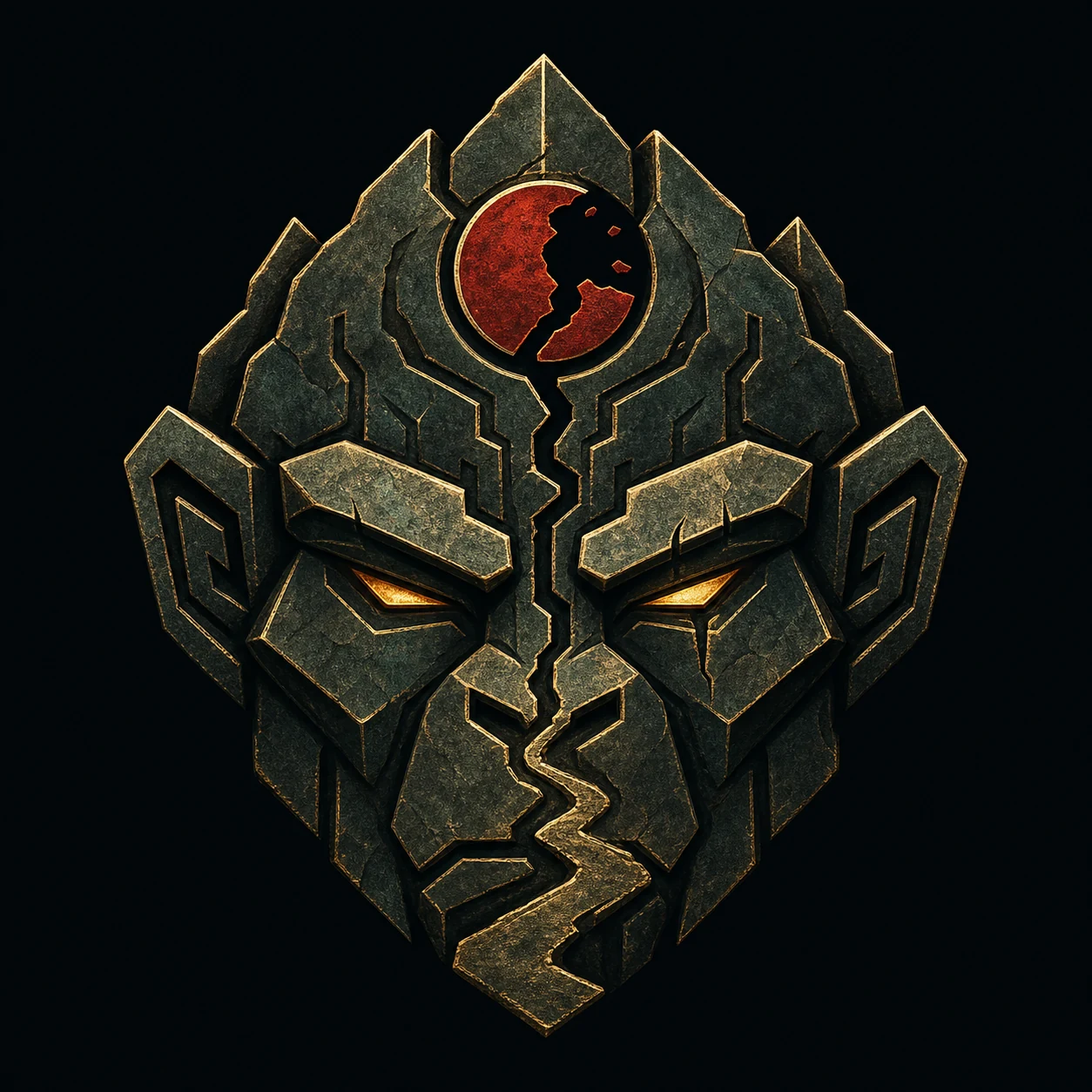
Let me say this first: I am no demon. The registers write me down as "earth-demon dual affinity" — let them write. An affinity is a fighting style. Demonhood is a choice. My style carries the demon strain. My choices never have.
I began as a road-keeper, same as old brother Shanxiao. He keeps the log bridge behind the mountain. I kept the ring of black stones around the Eclipse Altar.
Three hundred years ago that ring wasn't called an altar or anything else — just an old sacrificial ground, long abandoned. An easy posting: turn back monkey cubs at play, keep mushroom-pickers from wandering deep. Over the long years the black stones and I became old acquaintances, in a way. Stone is dead, and dead things don't frighten a yao.
The change began the year the black moon appeared.
First the stones began to sweat. On clear days a film of damp lay on them — and it wasn't cool to the touch. It was warm. Like the skin of something. Then the lines: the old carvings on the stones deepened by themselves, groove by groove, and where they deepened they branched, and the branching hairlines crawled out across the ground — all of them running toward the sea. Later still, on every full moon a column of smoke stood dead straight over the altar's center. The wind could not bend it.
I should have run. The keeper's rule: when the road itself becomes the pit, fall back and report.
But I am stubborn. I thought: if I fall back, what about the cubs who sneak in? What about the mushroom-pickers who stray? I not only stayed — I moved my den to the altar's edge and watched it day and night.
And watching it, I caught something.
The thing doesn't bite. It doesn't pounce. It… talks. The kind of talking that needs no ears. Night after night a thread of voice seeps from those hairline cracks, fine as a needle, sentence after sentence, every one of them aimed along the seams of your own heart. It said: you've kept this road all your life — who remembers you? It said: born with a face that makes humans scream and reach for clubs — why should you bear that? It said: no light enters your eyes because you refuse to open your true ones.
A day or two of that, I could stand. A year or two, I could still stand. But it never rests. Time is the one thing it has: three hundred years, to that thing, seem to pass like a single morning.
I am a yao, and yao tire too. One night I came within a single word of answering it. What saved me was no sage or master — it was the night watchman of Aolai Town, half a mountain below. His clapper drifted up through the dark: clack. Clack. I jolted awake: at this very hour, the human world was telling the human world all is well.
Someone down there was still keeping watch over others. Then I could still keep mine.
From that night I changed my method. It likes to bore in through the eyes, does it? Then every day I sear these eyes with my own yao-fire, once through. A fire-scoured eye lets no needle-voice in. Only — sear anything long enough and it stains: the whites went red, and the red will not fade again.
So the pair of red eyes you glimpse in the forest is not a demon wearing a shanxiao.
It is a shanxiao, holding the demon outside its eyes.
Then the herb-gathering boy came. He squatted in front of me a long while and said: your eyes are so red. Do they hurt?
Three hundred years. The first one ever to ask if it hurt.
I said no. A lie. Because in that moment I understood something that matters far more than eyes — that ring of black stone has talked at me for three hundred years, and every sentence urged the same thing: open your true eyes.
Why would it spend such effort persuading one small road-keeping yao?
Unless that is precisely what it fears: a yao that stays at the altar's edge, and watches it. Always.
What a thing that dreads being watched fears most of all — I don't know yet.
But I intend to keep watching until I find out.